
What is the Difference between Social Innovation, Social Enterprise and Social Entrepreneurship?


The start of a new academic semester brings fresh energy and familiar questions. Last week, as I kicked off another semester teaching social entrepreneurship at The University of Texas at Arlington, one question surfaced almost immediately:
What is the difference between social innovation, social enterprise and social entrepreneurship?
It’s the same question I hear in boardrooms, workshops and keynotes. And it is not coincidental. Academic research shows that social entrepreneurship education has expanded dramatically from its early roots in a few pioneering courses at Harvard, Stanford and Duke. Today, universities embed social entrepreneurship into undergraduate and graduate curricula across disciplines, and now we are even teaching executive education courses in social entrepreneurship, too.
As more people join the club we call “social entrepreneurs,” the need for shared terminology grows. More importantly, we need common definitions. Without them, these terms risk becoming meaningless. As the field has expanded, the language has blurred. Terms that once had distinct meanings are now used interchangeably, often within the same conversation. When that happens, we do not just confuse students. We weaken strategy, misalign funding and dilute impact. This is no longer an academic debate — it is a practical one.
After nearly three decades working as a practitioner, advisor and educator, I’ve found a simple way to explain the difference:
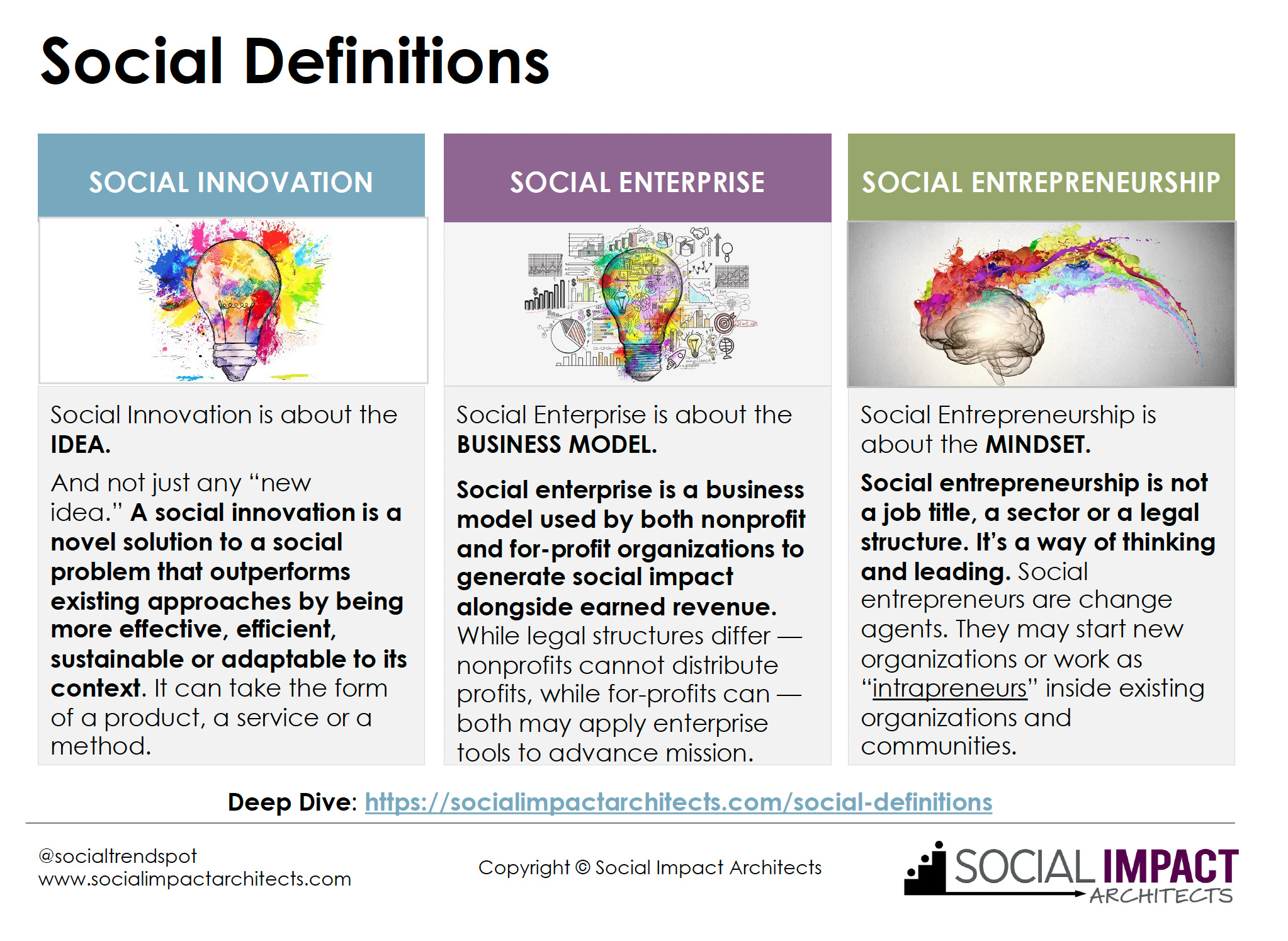
Social Innovation is about the IDEA.
Social Enterprise is about the BUSINESS MODEL.
Social Entrepreneurship is about the MINDSET.
Once you see the distinction, it’s hard to unsee it.
Social Innovation Is About the Idea
Social innovation should not be conflated with invention. It is not just any “new idea.” A social innovation is a novel solution to a social problem that outperforms existing approaches by being more effective, efficient, sustainable or adaptable to its context. It creates meaningful change and primarily benefits society.
In the social sector, innovation can take the form of a product, a service or a method. For example:
A cell phone — while once innovative — is not inherently a social innovation. But using mobile technology to diagnose disease in underserved communities can be.
Pay-for-success (or other performance-based contracts) is not a program. It is an innovative financing method designed to drive resources toward evidence-based programs at scale.
What Matters Most
To qualify as social innovation, an idea must be pressure-tested for impact. At its highest standard, it is refined over time and shared in ways that allow others to adapt and improve it. Innovation without evidence is just a good intention.
Social innovation answers the question: Is this solution truly better than what exists, and can we prove it?
When I talk to my class about the handoff between ideas and impact, I often talk about “leapfrog innovation.” All the best inventors or artists didn’t start from scratch. They were inspired by existing knowledge, best practices and context — and then pushed the work forward.
Social Enterprise Is About the Business Model
Social enterprise is a business model used by both nonprofit and for-profit organizations to generate social impact alongside earned revenue. While legal structures differ — nonprofits cannot distribute profits, while for-profits can — both may apply enterprise tools to advance mission.
A social enterprise may use philanthropic dollars to launch or support specific initiatives (e.g., case management), but it is intentionally designed to build meaningful earned revenue over time. Market discipline is applied in service of mission, not in place of it.
What Matters Most
Social enterprise is not defined by novelty. Some of the most successful social enterprises are not socially innovative at all. Thrift stores, cafés and staffing companies have existed for decades. What makes them social enterprises is not newness, but alignment between mission, model and margin.
Social enterprise ultimately answers a practical question: How will this work sustain itself financially while advancing impact — and what mix of revenue and support makes that possible?
Social Entrepreneurship Is About the Mindset
Social entrepreneurship is not a job title, a sector or a legal structure. It’s a way of thinking and leading. Social entrepreneurs are change agents who fall in love with the problem — not their own solution. They may start new organizations or work as intrapreneurs inside existing institutions, building cultures that support innovation and entrepreneurial thinking. They might lead a nonprofit, build a business, work at a Fortune 500 company, or serve in community or faith-based roles.
What Matters Most
What defines social entrepreneurs is not where they work, but how they work. Three principles consistently show up:
They fall in love with the problem, not the solution.
They believe no one owns a social solution. Instead, solutions should be co-created with the community to ensure sustainability and impact using a change management philosophy.
They treat impact as the bottom line.
They are both visionary and disciplined in their approach. They test, measure, adapt and scale using evidence-based approaches and models, such as lean startup and social alchemy.
Social entrepreneurship answers the question: How might we work as a team to reimagine a pressing social need in ways that are both catalytic and sustainable?
Why Social Innovators and Entrepreneurs Differ
A recent trend in the sector is the emphasis on social innovation, often through design thinking challenges and innovation contests that invite people to rethink entrenched problems. While valuable in the short-term, this approach can fall short when it’s disconnected from existing best practices and feasibility studies, which allow for a better launchpad for long-term sustainability.
Innovators tend to focus on developing and improving ideas, while entrepreneurs tend to focus on building the structures, systems and models that allow those ideas (either innovative or impactful) to scale and endure beyond their original creator. This is not a hard line. Many people do both. But the distinction is useful when designing solutions, building teams and deciding what kind of support is needed to sustain a healthy ecosystem of changemakers.
Why These Distinctions Matter
As the social sector navigates challenges, such as evolving funding landscapes, shifting economic and geopolitical conditions, and the need for deeper collaboration across sectors, we need “power tools” to shape a better world.
Every organization, public or private, shapes outcomes for people and communities. The goal is not to label ourselves correctly. The goal is to design solutions that actually work and to work together more effectively to shape a better world.
With a common framework, we stop arguing about semantics and start making more informed choices about strategy, funding, talent and measurement. Precision helps good ideas travel further and last longer. It will also go a long way to ensuring that the business sector respects not only our passion for the work, but our disciplined approach to building lasting solutions.
We would love to hear how you use these terms in your work, where confusion still shows up and why these distinctions matter in your organization. Share your thoughts and continue the conversation.