
Avoiding Analysis Paralysis: Market Research in the Age of AI


I love to travel. It’s not just about the trip itself. I also love planning the trip. Give me a destination, a cup of tea and a few hours to research, and I am a happy camper. Right now, I am digging into a trip to Scotland next year.
A few years ago, I wrote a blog about planning a trip to Hawaii. At the time, I joked that after two hours of online research I had more questions than answers. Looking back, that problem now feels almost quaint.
Today, we have travel websites, social media influencers, YouTube videos, online reviews, AI-generated itineraries and recommendations from friends all competing for our attention. The amount of information available is staggering.
Yet somehow many of us still end up feeling stuck. Sound familiar?
For years, one of the biggest challenges facing organizations was access to information. Today, the challenge is often the opposite. We are drowning in it.
Nonprofits face this every day. Whether we are developing a strategic plan, evaluating a new program, exploring a social enterprise opportunity, conducting a feasibility study, or responding to changing community needs, there is no shortage of data. Add artificial intelligence to the mix and the amount of available information has exploded.
The challenge is no longer finding answers. The challenge is identifying which questions matter most.
When organizations fail to do that, they often find themselves stuck in what I call “analysis paralysis.” They gather more reports, launch more surveys, hold more meetings and continue discussing the issue without getting closer to a decision.
Fortunately, there is a better way. It is an approach I have taught for years called backward market research.
What Is Backward Market Research?
Most organizations begin research by gathering information. They start searching, surveying, interviewing and collecting data. Before long, they have stacks of information but are still not sure what to do next.
Backward market research flips the process.
Instead of starting with the data, start with agreement on the decision. What decision are you trying to make? What information would help you make that decision with confidence? Only then should you begin collecting information.
This approach works whether you are planning a vacation, launching a social enterprise, evaluating a new program or making a major strategic investment. In fact, I would argue it is more important today than ever before because AI can generate information faster than any of us can consume it.
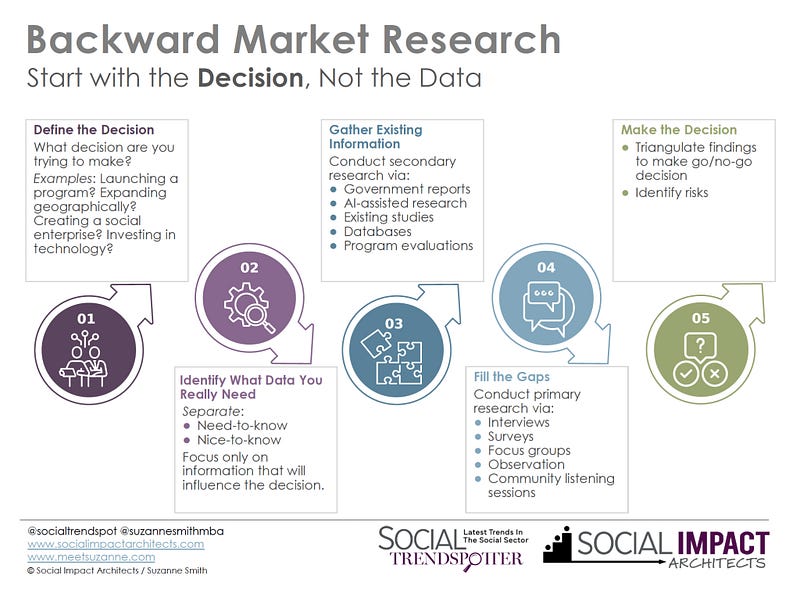
Download the printable PDF version of this graphic
Here are five steps to put backward market research into practice.
Step 1: Define the Decision
Too often organizations jump into research that generates more information but little clarity. Avoid that trap by asking yourself two simple questions:
What questions are we trying to answer?
How will we use the information?
Market research should be driven by the decisions you need to make. Before you collect a single piece of data, create a roadmap that identifies both what you hope to learn and what success will look like at the end of the process.
The most expensive research project is the one that never leads to a decision. This step is more important than ever in the age of AI. Tools can summarize reports, identify trends, conduct competitive research, and provide recommendations almost instantly. Those capabilities are incredibly valuable. But if you have not defined the decision you are trying to make, AI simply helps you get lost faster.
Good research starts with clarity.
Step 2: Identify What Data You Really Need
Once you have identified your research questions, determine which information is essential to making an informed decision. Notice I said essential. One of the biggest challenges I see among nonprofit leaders is confusing curiosity with necessity. Just because information is available does not mean it is useful. There is a difference between information that is nice to know and information that is necessary to know.
When planning my Hawaii trip, I could have spent days researching restaurants, attractions, hidden beaches and travel hacks. Instead, I focused on the questions that would have the greatest impact on my decisions. What would the weather be like? Which islands best matched the experience I wanted?
The same principle applies to nonprofit leadership. Whether you are evaluating a new initiative, considering an expansion or assessing a new revenue opportunity, focus on the information that will influence the decision at hand.
That discipline prevents research from becoming overwhelming and helps organizations stay focused on what matters most. It also prevents research fatigue. For example, if you are asking a question in a survey and the answer will not directly influence a decision, consider deleting it.
Step 3: Gather Existing Information
Only after the first two steps are complete should you begin gathering information. Start with secondary research — information that already exists — such as:
Government reports
Foundation research
Industry studies
Academic publications
Community assessments
Existing evaluations
Twenty years ago, secondary research often meant hours in libraries, searching databases and reports. Today, AI can help summarize information in minutes, which is a tremendous advantage. Tools like ChatGPT, Claude, Gemini, Perplexity and NotebookLM can help organize findings, identify patterns and accelerate learning.
But remember, AI is only as good as the questions you ask and the sources behind the answers. AI can help you find answers faster. It cannot tell you which questions matter most. Like any research assistant, AI works best when given clear instructions. Ask for citations. Ask for publication dates. Ask where the information originated. If you are researching a rapidly changing topic, specify the timeframe you want included. In short, trust, but verify.
Step 4: Fill the Gaps
Once you have exhausted secondary research, move to primary research to fill in the gaps. Primary research means connecting directly with the work and the people closest to it. It may include:
Interviews
Surveys
Focus groups
Observation
Community listening sessions
For example, after reviewing travel websites and guidebooks, I may still have questions that only experienced travelers can answer. That is when I turn to friends, colleagues and my network for additional insights. The same is true in the social sector. Sometimes the most valuable insights come directly from the people we serve.
Step 5: Make the Decision
One of the reasons I have appreciated the Lean Startup approach is that it encourages leaders to test assumptions before making significant investments. Too often organizations fall in love with a solution before they fully understand the problem.
Backward market research helps us do the opposite. It forces us to fall in love with the problem first. It forces us to slow down, ask better questions, challenge our assumptions, and understand what is actually happening before committing precious resources.
In some cases, the research confirms our instincts. In others, it reveals that we need to change direction. Both outcomes are valuable. Learning before you invest is far less expensive than learning afterward.
Whether we are launching a new program, evaluating a social enterprise opportunity or developing a strategic plan, the goal is not to prove that we are right. The goal is to learn enough to make an informed decision.
Final Thoughts
Artificial intelligence is changing how we gather information. It is not changing the importance of judgment. The leaders who succeed in the years ahead will not be the ones with the most data. They will be the ones who know what decisions they need to make, what information truly matters and when they have learned enough to move forward.
In a world overflowing with information, this may be the ultimate competitive advantage. So, before you launch the next survey, commission the next study or ask AI for another round of answers, start with a simpler question: What decision am I trying to make?
Because good market research is not really about research. It is about making better decisions.
We would love to hear how you have honed your market research skills in the age of AI.